
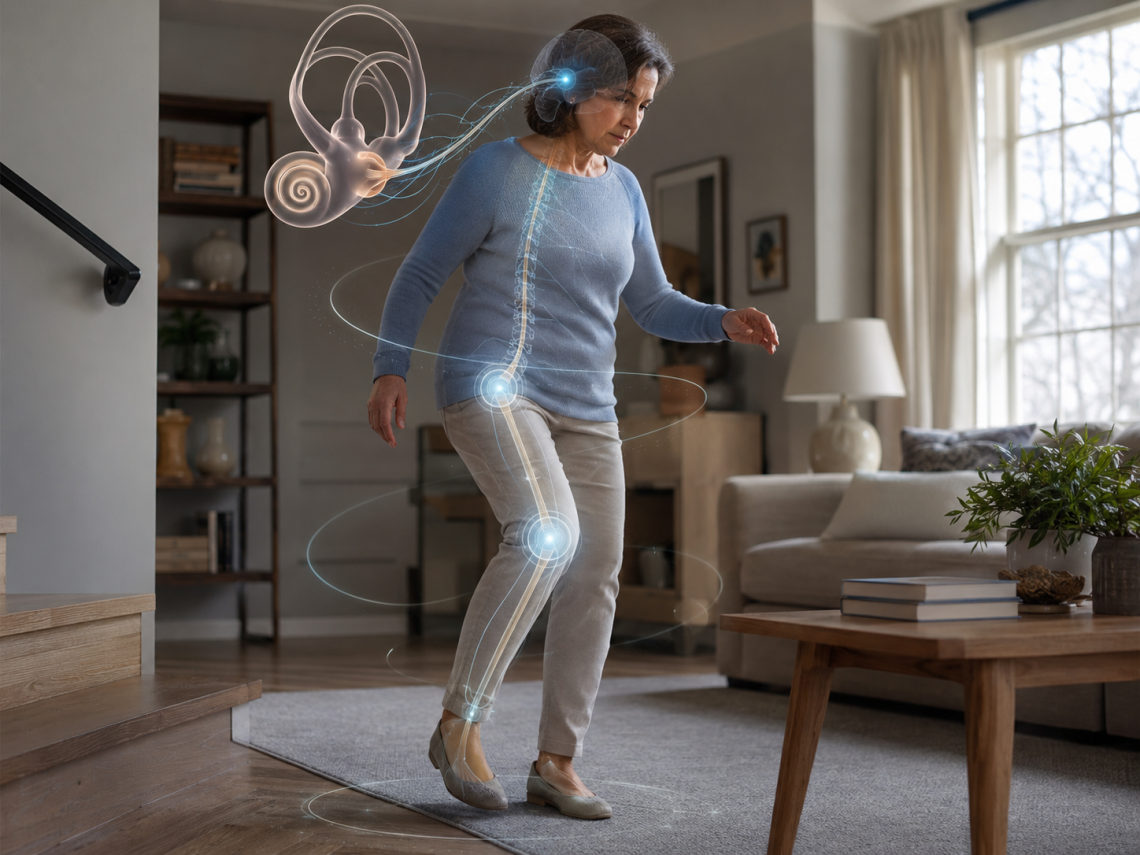
Balance problems can sneak up slowly.
At first, you may notice small things. You feel less steady on stairs. You hold the wall when walking in the dark. You avoid uneven ground. You stand up and need a second before moving. You feel less confident turning quickly.
Many adults explain this away as age.
But balance is not controlled by age alone. It depends on your eyes, inner ears, muscles, joints, nerves, brain, blood pressure, medications, and daily movement habits all working together.
When one part of that system becomes weaker, slower, or less reliable, stability can start to feel less automatic.
Quick answer
Balance can become harder after 50 because vision changes, inner ear issues, reduced muscle strength, joint stiffness, nerve changes, medications, low activity, dizziness, and blood pressure changes can all affect how steady you feel. The problem is usually not one single thing. It is often several small changes adding up.
Balance Is A Full Body System
Most people think balance is just strong legs.
Leg strength matters, but balance is bigger than that. Your body is constantly collecting information from several systems at once.
Your eyes tell you where you are. Your inner ears help detect motion and position. Your feet, joints, and muscles tell your brain where your body is in space.
Then your brain has to combine all of that information fast enough to keep you upright.
When one part becomes less reliable, the others have to work harder.
Vision helps your brain understand distance, obstacles, movement, and where the ground is.
The balance organs inside the ears help detect head movement and changes in position.
Muscles, joints, and nerves tell your brain where your feet, legs, and body are in space.
1. Muscle Loss Makes Stability Harder
One reason balance can feel worse with age is reduced muscle strength.
The legs, hips, core, ankles, and feet all help keep you steady. If those muscles become weaker, slower, or less responsive, small balance corrections become harder.
This can show up when you:
- Stand up from a low chair
- Walk on uneven ground
- Step off a curb
- Climb stairs
- Turn quickly
- Carry groceries while walking
Balance requires quick adjustments. If the muscles are weaker, the body has less backup when something shifts unexpectedly.
You do not only need strength to lift heavy things. You need strength to catch yourself before a small wobble becomes a fall.
2. Stiff Joints Change How You Move
Stiff hips, knees, ankles, and feet can make balance less smooth.
When joints move well, your body can make small adjustments without much effort. When joints are stiff or painful, your movement becomes more guarded.
You may start taking shorter steps, walking slower, avoiding stairs, or holding your body more tightly.
That stiffness can make balance feel less natural.
| Smooth movement | Your hips, knees, ankles, and feet adjust naturally as the ground changes. |
| Stiff movement | Your steps become shorter, slower, or more cautious, which can reduce stability. |
| What you may notice | Feeling unsure on stairs, uneven ground, slopes, curbs, or slippery floors. |
3. Vision Changes Can Make Balance Less Reliable
Balance depends heavily on vision.
If your vision becomes blurry, your depth perception changes, your glasses are outdated, or you have trouble seeing in dim light, your brain gets less reliable information about the world around you.
This is why many adults feel less steady:
- At night
- On stairs
- In unfamiliar places
- On patterned floors
- When stepping over objects
- When moving from bright to dark areas
Even small vision changes can affect confidence and stability.
Your eyes help your brain confirm where the floor, furniture, stairs, and obstacles are.
Your body has to rely more on feet, joints, inner ears, and memory of the room.
4. Inner Ear Problems Can Create Dizziness Or Vertigo
The inner ear plays a major role in balance.
When the inner ear sends confusing signals, you may feel dizzy, lightheaded, unsteady, or like the room is spinning. That spinning feeling is often called vertigo.
Inner ear related balance issues can make simple movements feel strange, such as turning over in bed, looking up, bending down, or standing quickly.
Possible clues include:
- A spinning sensation
- Feeling pulled to one side
- Nausea with dizziness
- Unsteadiness after head movement
- Dizziness when rolling over in bed
- Feeling worse in busy visual environments
Dizziness is not something to ignore if it keeps happening. The cause can vary, and the right next step depends on what is driving it.
5. Nerve Changes Can Make Your Feet Less Informative
Your feet do more than carry your weight.
They constantly send information to your brain about pressure, surface, position, and movement. If the nerves in the feet are not sending clear signals, balance can become harder.
This can happen with nerve related conditions such as peripheral neuropathy. Some people notice numbness, tingling, burning, weakness, or a reduced sense of where their feet are.
Numbness, tingling, or reduced sensation can make the ground feel less certain.
Your brain has less information about foot placement and surface changes.
You may feel more cautious, especially in the dark or on uneven ground.
6. Medications Can Affect Balance
Medication side effects are an important cause to consider, especially when balance problems start after a new prescription, dose change, or combination of medicines.
Some medications may contribute to dizziness, sleepiness, lightheadedness, slower reaction time, or changes in blood pressure.
This does not mean you should stop a prescribed medication on your own.
It means new balance issues are worth discussing with a healthcare professional, especially if you also feel faint, confused, unusually sleepy, or unsteady.
Before your next appointment, write down these details.
7. Blood Pressure Changes Can Make You Feel Unsteady
Some people feel off balance when standing up quickly.
This may happen when blood pressure drops after standing, which can make you feel lightheaded, faint, weak, or unsteady for a moment.
Other circulation related issues can also make a person feel dizzy or off balance.
Pay attention if unsteadiness appears when you:
- Stand up from bed
- Get out of a chair
- Stand after bending down
- Walk after sitting for a long time
- Feel dehydrated or overheated
If this happens often, it is worth getting checked, especially if you faint or nearly faint.
8. Fear Of Falling Can Make Balance Worse
After one scary stumble, many adults start moving less.
This is understandable. If you feel unstable, you naturally want to avoid situations that feel risky.
But moving less can make the body weaker, stiffer, and less confident. Over time, that can make balance feel even worse.
| A stumble happens | You become more cautious and avoid certain movements. |
| You move less | Strength, coordination, and confidence may decline. |
| Balance feels worse | Daily movement starts feeling more risky than it used to. |
When Balance Problems Need Faster Attention
Some balance problems are gradual and should be discussed at a regular medical appointment.
Others need faster attention, especially if symptoms are sudden, severe, or come with signs that could involve the brain, heart, circulation, or nervous system.
Seek urgent medical help if balance problems appear suddenly or come with concerning symptoms.
Simple Ways To Support Better Stability
Balance can often be improved, depending on the cause.
The first step is not to push through blindly. It is to identify what is making stability harder, then work on the right area.
Notice whether balance feels worse in the dark, after standing, on stairs, after medication, or with dizziness.
Leg, hip, core, and ankle strength can help the body correct small wobbles.
Vision changes and foot numbness can quietly affect stability.
A healthcare professional can review whether side effects or interactions may be involved.
What To Track For 7 Days
A short balance log can make the cause easier to understand.
Write down when you feel unsteady, what you were doing, and whether dizziness, weakness, vision changes, pain, or medication timing was involved.
| When it happens | Morning, after standing, at night, after meals, after medication, or during walking. |
| What it feels like | Dizzy, spinning, faint, weak, wobbly, pulled to one side, or unsure on your feet. |
| Where it happens | Stairs, bathroom, uneven ground, dark rooms, crowded places, or outdoors. |
| What helps | Sitting, holding support, better lighting, hydration, eating, rest, or slower movement. |
FAQ
Why does balance get worse after 50?
Balance can worsen after 50 because several systems may change at the same time, including vision, inner ear function, muscle strength, joint mobility, nerve sensation, medications, blood pressure, and daily activity levels.
Is dizziness the same as poor balance?
Not always. Dizziness can feel like spinning, faintness, lightheadedness, or unsteadiness. Poor balance can also happen without dizziness, especially when strength, vision, nerves, or joint movement are involved.
Can weak legs cause balance problems?
Yes. Weakness in the legs, hips, ankles, and core can make it harder to correct small wobbles, climb stairs, step off curbs, and walk confidently on uneven ground.
Can medications make balance worse?
Yes. Some medications can contribute to dizziness, sleepiness, lightheadedness, slower reaction time, or blood pressure changes. Do not stop medication on your own, but discuss new balance symptoms with a healthcare professional.
When should I worry about balance problems?
Seek urgent help if balance problems appear suddenly or come with weakness, numbness, trouble speaking, confusion, chest pain, shortness of breath, fainting, severe headache, facial drooping, double vision, or new trouble walking.
Can balance improve with exercise?
Balance can often improve with appropriate strength, mobility, and balance training, depending on the cause. A healthcare professional or physical therapist can help choose safe exercises if symptoms are frequent or concerning.
Educational Disclaimer
This article is for educational purposes only and is not medical advice. If you have sudden balance problems, dizziness, fainting, weakness, numbness, trouble speaking, confusion, chest pain, shortness of breath, severe headache, double vision, facial drooping, new trouble walking, or any concerning symptoms, seek medical help promptly or speak with a qualified healthcare professional.

